Cannabis CFO: Navigating the Inflection Point Between Fractional and Full-Time
As cannabis rescheduling nears, MSOs must transition from startup financial habits to institutional-grade infrastructure to survive the “dash for the map.” This article breaks down the strategic choice between fractional “special ops” specialists and full-time institutional architects. You’ll learn how to identify your company’s specific capacity needs, build a supporting “financial tower,” and clean up operations to secure the lowest cost of capital in a post-280E landscape.

Impending cannabis rescheduling and 280E sunsetting are creating a “dash for the map” for cannabis companies. MSOs are no longer just surviving; they are sprinting towards rapid expansion and establishing a national brand.
The issue is that many enterprise-level cannabis companies are still running on “startup” financial infrastructure, with fractional financial roles spreading focus too thin. Fractional vs full-time CFOs is about more than hiring someone; it’s about establishing financial operations that can handle the organizational inertia of rapid expansion that rescheduling will bring within the cannabis industry. Choosing between a fractional and full-time cannabis CFO isn’t a budget decision—it’s a capacity decision.
The Fractional Cannabis CFO: The Special Ops Phase
A fractional CFO role works best for MSOs in the $2M–$15M revenue range. This role can also work well if a company is entering a specific transitional phase and needs strategic financial planning advice from a specialist, such as preparing for a first major debt round or performing a financial audit in advance of selling a company.
Key Strengths of Fractional Chief Financial Officers for Cannabis Companies
Fractional cannabis CFOs are clean-up specialists. They’re experts at coming into a business, identifying what needs to be done within the financial operations, and doing it.
Say you own a cannabis company that operates in three states. Pending a change in cannabis’s federal status, you want to ensure your financials are in order. A fractional CFO can come in and clean up messy, multi-state books in compliance with GAAP standards.
If you’re interested in selling your company, a fractional CFO can create the data rooms and models needed to attract the first wave of institutional private equity or investment. Investors hate messy books; a fractional CFO can provide an unbiased, external view of your unit economics and margin leaks across different state licenses, helping you tighten up and present the most attractive financial strategy and business model to potential investors.
The Limit of Fractional CFO Services
A fractional role is, in its most basic essence, a contractor. Contractors have multiple clients at once, and do not dedicate all of their working hours to a single company. A part-time financial role begins to hit its limits when a company grows too large.
Cannabis businesses that operate in more than three states or are aggressively integrating vertically across multiple states require more complex financial reporting than a fractional role is able to serve well.
The Full-Time CFO: The Institutional Architect
A traditional full-time CFO role is best suited for large cannabis businesses managing multiple tax jurisdictions and a complex financial strategy, such as annual M&A or growth plans to go public.
When Cannabis Businesses Need a Full-Time CFO
If your company is:
- Operating in 4 or more tax jurisdictions
- Dealing with intercompany transfers
- Facing consolidated audits
- Undertaking one or more M&A deals annually with complex transactional liability
Then congratulations! It’s time for a permanent cannabis CFO hire. The larger a company is, the more complex its financial operations become, and the more it needs the dedicated oversight of a full-time cannabis CFO. Additionally, many major lenders and auditors require a dedicated CFO to sign off on findings and controls, which should be part of strategic financial planning.
A CFO takes the reins on a company’s financial strategy and future, moving from financial reporting on what happens from month to month to architecting what happens next, with strategic insights in capital allocation, tax strategy, and investor relations.
Scaling the Finance Tower: Building the Team Around the Cannabis CFO
As great as they are, a CFO (even a full-time one) is not a “super accountant.” Cannabis CFOs cannot single-handedly scale large, complex cannabis companies like an MSO. They must have support in order to oversee every detail of complicated financial operations and provide financial leadership.
Accounting Professionals Needed in MSOs:
- The Controller: The “engine room” manager focused on daily accuracy, timely financial reporting, and internal controls.
- FP&A Analysts: The “navigators” who model the impact of rescheduling on cash flow.
- Hybrid Approach: Keeping on fractional financial specialists for high-level, detail-oriented tasks, like tax strategy or M&A integration.
There are many ways to build a financial tower capable of rapid growth within the cannabis industry, but the surest way not to scale is by expecting a CFO to manage everything alone.
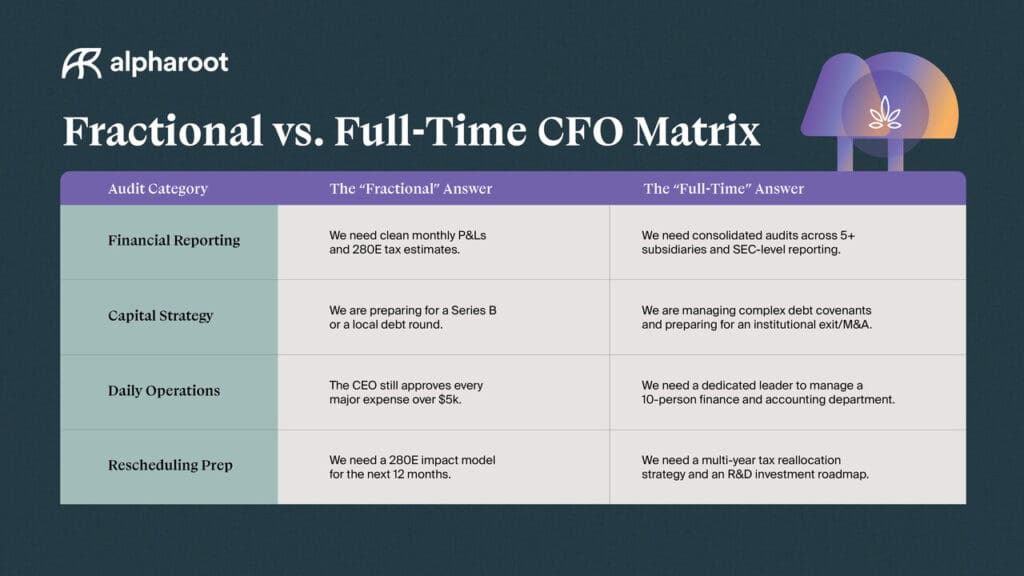
The Decision Matrix: Fractional vs. Institutional Finance
The decision of a fractional CFO services versus a full-time cannabis CFO has a big impact on the success of cannabis companies. If you’re still not sure which role is best for your company, consider the following.
Complexity & Cash Flow Management
The complexity of your operations has a big impact on whether a full-time or fractional role will serve you best. Smaller businesses with a focus on accurate financial reporting may be better served with a fractional role, while large, complex operations need the attention of someone full-time for effective financial management.
- Full-time: You need a leader to manage the culture and people across 10+ locations daily.
- Fractional: You need to fix the architecture of your debt and systems once and for all.
Deal Pipeline
How busy is your company, and where is that attention focused? A full-time finance role helps larger companies with one singular point of contact, while a fractional finance role is ideal for getting your company’s books in order
- Full-time: You want a “face” of financial leadership for the company to build long-term relationships with Wall Street.
- Fractional: You need a “closer” to audit the books and prep the data room for a specific 12-month exit window.
Cannabis Accounting Compliance
Larger companies have heavier compliance burdens to run smooth business operations, and the finance piece of this puzzle is vital.
- Full-time: You are moving toward institutional-grade capital (Tier 1 debt or private equity), where a dedicated, in-house officer is required to sign off on the rigorous audit, compliance standards, and insurance tower that these lenders demand.
- Fractional: You need to outsource the headache of 280E transition to a team that has done this for dozens of other MSOs.
Leading from the Ledger in the Cannabis Industry
Is your current finance stack a growth lever or a bottleneck for success in the cannabis industry?
In the post-rescheduling era, the winner won’t be the cannabis businesses with just the best flower—it will be the company with the lowest cost of capital, the cleanest governance, and the strongest product.
Scaling at high velocity requires more than just capital—it requires institutional-grade infrastructure. From D&O towers that protect your board to PEO solutions that stabilize your multi-state workforce, protecting your cannabis company takes strategy, robust internal controls, and a willingness to pivot when needed.
Protecting your cannabis company can seem confusing; however, we’re a full-service insurance brokerage working with carriers worldwide to offer you the best coverage possible. We’re here to help! Please reach out to us today by email info@alpharoot.com or calling 646-854-1093 for a customized letter or learning more about your cannabis insurance options.